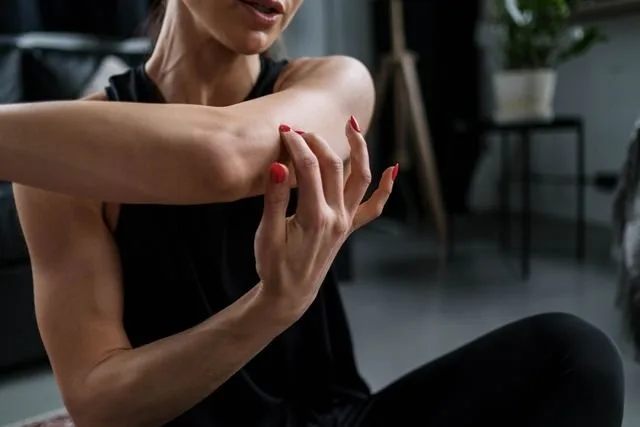
Tennis elbow can make everyday activities unexpectedly painful. Opening a jar, lifting a shopping bag, typing at a desk, shaking hands, using a screwdriver, or picking up a child can all become uncomfortable when the muscles and tendons around the outside of the elbow are overloaded.
Despite its name, tennis elbow does not only affect tennis players. The condition can develop in anyone who repeatedly uses the wrist and forearm, including people who work at computers, use tools, perform manual work, play sports, or regularly perform repetitive gripping activities.
At Renew Physiotherapy and Sports Clinic, physiotherapy is designed around the individual’s condition, activity level and recovery goals. A comprehensive assessment can help determine what may be contributing to elbow pain and whether physiotherapy, exercise-based rehabilitation, manual therapy or other treatment options may be appropriate.
What Is Tennis Elbow?
These muscles attach to the outer part of the elbow through tendons. When the area is repeatedly exposed to more load than it can comfortably tolerate, symptoms may develop.
Despite the term “epicondylitis,” tennis elbow is not necessarily caused by simple inflammation. Tendons can undergo changes related to repeated loading, reduced capacity, and inadequate recovery. This is one reason why simply resting for a few days may not always solve a persistent case.
Tennis elbow can affect people who have never played tennis.
The condition may develop following:
- Repetitive gripping
- Manual work
- Racquet sports
- Weight training
- Gardening
- Repetitive computer or mouse use
- Construction or trade work
- Lifting activities
- Certain occupational tasks
- Sudden increases in physical activity
When the demands placed on the forearm repeatedly exceed what the tissues can tolerate and recover from, symptoms may gradually appear.
What Does Tennis Elbow Feel Like?
The most common symptom is pain around the outside of the elbow.
However, the discomfort may extend into the forearm and become more noticeable during activities involving gripping or wrist movement.
Common symptoms include:
- Pain on the outside of the elbow
- Tenderness around the outer elbow
- Forearm discomfort
- Pain when gripping objects
- Pain when lifting
- Discomfort when turning a door handle
- Pain while using tools
- Difficulty carrying bags
- Reduced grip strength
- Pain when extending the wrist
- Discomfort during sports activities
- Stiffness or aching after repetitive activity
Some people experience pain only during specific movements. Others may notice an ache that continues after activity or becomes more noticeable later in the day.
The severity of symptoms can also fluctuate.
You may have days when the elbow feels relatively normal and other days when even simple movements become uncomfortable.
This variation does not necessarily mean that the condition is getting worse. Tendon-related pain can respond to changes in workload, recovery, stress, sleep, activity and other factors.
Why Is It Called Tennis Elbow?
The condition received its popular name because tennis players can develop pain around the outside of the elbow from repeated racquet movements and gripping.
However, tennis players represent only a portion of people who experience this problem.
You can develop tennis elbow without ever holding a tennis racquet.
For example, a person who spends several hours using hand tools at work may place substantial repetitive stress on the same muscle-tendon structures.
Similarly, someone who suddenly starts weight training or increases their racquet-sport activity may expose the tissues to a level of load they are not currently prepared to handle.
So the name is useful, but slightly misleading.
What Causes Tennis Elbow?
There is usually no single cause.
Instead, tennis elbow can develop when repeated loading of the wrist and forearm exceeds the tissues’ ability to adapt.
Several factors can contribute.
Repetitive Gripping
Repeated gripping is one of the most common contributors.
Activities that require you to repeatedly squeeze, hold, twist or manipulate objects can increase the workload on the forearm muscles.
This can happen during:
- Tool use
- Weightlifting
- Racquet sports
- Gardening
- Manual labour
- Household tasks
- Certain workplace activities
The problem may become more likely when the activity suddenly increases in duration or intensity.
Sudden Increase in Exercise
You may develop tennis elbow after changing your training routine.
For example, you might suddenly increase:
- Weight
- Repetitions
- Training frequency
- Racquet-sport sessions
- Manual exercise volume
The muscles and tendons need time to adapt to increased workload.
When the increase happens too quickly, symptoms may appear.
Poor Load Management
The issue is not necessarily that an activity is harmful.
Instead, the amount, frequency and intensity of the activity may exceed your current capacity.
A tennis player who plays one hour twice a week may tolerate their routine comfortably. Increasing that to two hours every day without appropriate progression is a very different physical demand.
Occupational Repetition
Certain jobs involve thousands of repetitive movements throughout the day.
Tradespeople, warehouse workers, mechanics, cleaners, cooks, healthcare workers and other professionals may repeatedly grip, lift, carry or manipulate objects.
If the workload remains high without sufficient recovery, the elbow may become irritated.
Weakness or Reduced Capacity
If the muscles of the wrist, forearm and upper limb are not accustomed to a particular workload, they may fatigue sooner.
This can affect how forces are distributed through the elbow.
Strength training and progressive rehabilitation can therefore play an important role in improving load tolerance.
Technique and Movement Patterns
The way you perform a movement can influence the amount of stress placed on the elbow.
For athletes, technique may be relevant.
For workers, tool position, grip, posture and repetitive movement patterns may matter.
However, technique should not automatically be blamed for every case of tennis elbow. Human movement is complex, and there is rarely one perfect position that prevents all injuries.
A physiotherapy assessment can help determine whether movement patterns are actually relevant to your symptoms.
Who Is Most at Risk of Tennis Elbow?
Tennis elbow can affect almost anyone, but certain activities may increase exposure to repetitive forearm loading.
You may be more likely to develop symptoms if you:
- Play tennis or other racquet sports
- Perform manual work
- Use tools frequently
- Lift weights
- Garden regularly
- Perform repetitive gripping tasks
- Work at a computer for long periods
- Recently increased your training volume
- Have previously experienced elbow or forearm problems
Age can also influence tendon health and recovery, but tennis elbow is not limited to a particular age group.
Tennis Elbow vs Golfer’s Elbow
Tennis elbow and golfer’s elbow are often confused because both involve the elbow and can be related to repetitive activity.
The main difference is the location of the pain.
The muscles and tendons involved are different.
Because several conditions can cause elbow pain, an accurate assessment is useful before assuming that you have tennis elbow.
How Is Tennis Elbow Diagnosed?
Tennis elbow is generally diagnosed through a combination of your medical history, symptoms and physical assessment.
A physiotherapist may ask about:
- When your pain started
- Whether it developed gradually or suddenly
- What activities aggravate it
- Your work
- Sports participation
- Recent changes in activity
- Previous injuries
- Pain severity
- Changes in grip strength
- Activities you are currently unable to perform
The physical assessment may include:
- Elbow movement
- Wrist movement
- Grip strength
- Forearm strength
- Shoulder and upper-limb function
- Tenderness
- Functional movements
- Specific loading tests
The purpose is to understand the source of the symptoms and determine whether the presentation is consistent with tennis elbow.
It also helps identify whether another condition could be responsible.
Can Physiotherapy Help Tennis Elbow?
Yes. Physiotherapy can be an effective part of managing tennis elbow, particularly when treatment combines symptom management with progressive rehabilitation.
The goal is not simply to make the elbow hurt less for a few hours.
A comprehensive approach aims to improve the capacity of the muscles and tendons to tolerate the activities that matter to you.
- Exercise therapy
- Progressive strengthening
- Manual therapy
- Activity modification
- Education
- Taping or bracing
- Dry needling when clinically appropriate
- Other physical therapy modalities when appropriate
The exact combination depends on your symptoms, goals and assessment findings.
What Happens During Tennis Elbow Physiotherapy?
Step 1: Understanding Your Symptoms
Your physiotherapist will first want to understand what you are experiencing.
The same diagnosis can present differently in different people.
A recreational tennis player may want to return to competition. A tradesperson may simply need to work without pain. Someone who works at a computer may want to use a mouse without discomfort.
Your goals influence the rehabilitation plan.
Step 2: Physical Assessment
Your physiotherapist may assess:
- Elbow range of motion
- Wrist mobility
- Grip strength
- Forearm strength
- Shoulder function
- Movement patterns
- Pain during loading
- Functional tasks
This helps identify areas that may require attention.
Step 3: Reduce Excessive Irritation
If your elbow is currently being overloaded, treatment may initially involve modifying aggravating activities.
That does not necessarily mean complete rest.
Instead, the aim is to find an appropriate level of activity that allows the tissues to recover while maintaining movement and function.
Step 4: Progressive Strengthening
Strengthening is often an important part of rehabilitation.
The programme may gradually target:
- Wrist extensors
- Wrist flexors
- Forearm muscles
- Grip strength
- Shoulder muscles
- Upper-limb control
The exercises can become progressively more challenging as your tolerance improves.
Step 5: Return to Normal Activities
The final goal is not simply to perform exercises in a clinic.
It is to return to the activities you actually care about.
That may include:
- Tennis
- Golf
- Gym training
- Manual work
- Gardening
- Household activities
- Lifting
- Workplace tasks
Rehabilitation should therefore progress toward real-world demands.
What Exercises Help Tennis Elbow?
Exercise selection depends on the individual, but rehabilitation may involve several types of strengthening.
Wrist Extension Exercises
The muscles that extend the wrist are commonly involved in tennis elbow.
Strengthening these muscles can gradually improve their ability to tolerate load.
Grip Strengthening
Grip exercises can help improve forearm capacity.
However, the amount of gripping should be appropriate for your current symptoms.
More is not automatically better.
Isometric Exercises
Isometric exercises involve contracting a muscle without significant joint movement.
They may sometimes be used during earlier stages of rehabilitation when dynamic movements are uncomfortable.
Progressive Resistance Training
As symptoms improve, resistance can gradually increase.
This progression is important because the long-term goal is usually to improve load tolerance rather than keep the arm permanently protected.
Shoulder and Upper-Limb Strengthening
Your elbow does not work in isolation.
The shoulder, arm, forearm and hand all contribute to movement.
Depending on your assessment, strengthening other parts of the upper limb may be useful.
Should You Stop Using Your Arm?
Usually, completely stopping all arm activity is not necessary.
In fact, prolonged avoidance can sometimes make it harder to rebuild capacity.
Instead, activity modification is often more practical.
For example, you might temporarily reduce:
- Heavy lifting
- Repetitive gripping
- High-volume tennis
- Painful gym exercises
- Prolonged tool use
As your tolerance improves, these activities can gradually be reintroduced.
How Long Does Tennis Elbow Take to Heal?
Recovery time varies significantly.
Some people improve within several weeks, while others experience symptoms for several months.
Factors that may influence recovery include:
- How long symptoms have been present
- Severity of symptoms
- Occupational demands
- Training volume
- Rehabilitation consistency
- Sleep and recovery
- Previous injuries
- Ability to modify aggravating activities
- Overall physical capacity
Persistent symptoms do not necessarily mean that something is seriously wrong.
Tendon-related conditions can take time to respond to progressive loading.
The important thing is to monitor progress and adjust the rehabilitation programme when necessary.
Can You Play Tennis With Tennis Elbow?
You may not need to stop tennis completely, but the appropriate approach depends on your symptoms and playing demands.
If playing causes significant pain that persists after activity, reducing volume or modifying your sessions may be appropriate.
A gradual return could involve:
- Shorter sessions
- Lower intensity
- Longer recovery periods
- Reduced frequency
- Gradual increase in playing time
- Return to normal competition once tolerance improves
Your physiotherapist can help determine how to progress based on your symptoms.
Tennis Elbow Treatment for Athletes
Athletes often want to return to their sport as quickly as possible.
However, returning too early can create a cycle:
A better approach is to gradually rebuild capacity.
For racquet-sport athletes, rehabilitation may eventually include:
- Grip strengthening
- Forearm endurance
- Wrist strengthening
- Racquet-specific movements
- Progressive hitting
- Training-load management
- Technique review where appropriate
The goal is to prepare the elbow for the actual demands of the sport.
Tennis Elbow Treatment for Manual Workers
Manual workers face a different challenge.
They may not be able to simply take several weeks away from work.
In that situation, treatment needs to account for the actual workplace demands.
Your physiotherapist may help you consider:
- Workload modification
- Grip changes
- Tool handling
- Rest breaks
- Alternating repetitive tasks
- Gradual strengthening
- Work-specific exercises
The aim is to improve your ability to tolerate your occupational demands rather than simply reduce activity indefinitely.
Can Shockwave Therapy Help Tennis Elbow?
Shockwave therapy is used in physiotherapy for a range of musculoskeletal conditions.
For tennis elbow, whether shockwave therapy is appropriate depends on the individual’s symptoms, clinical presentation and treatment goals.
It should not be considered a replacement for rehabilitation.
A comprehensive approach may combine symptom-management strategies with progressive strengthening and activity modification.
Can Dry Needling Help Tennis Elbow?
Dry needling is another treatment technique used by some physiotherapists to address muscular pain and dysfunction.
Whether it should be included in your treatment depends on your assessment.
Like other passive treatment approaches, dry needling should ideally support a broader rehabilitation programme rather than become the entire treatment strategy.
Can Massage Help Tennis Elbow?
Massage may help reduce muscle tension or provide temporary symptom relief in some people.
However, massage alone may not address the underlying issue of reduced tendon or muscle capacity.
For persistent tennis elbow, a combination of exercise, load management and appropriate hands-on treatment may provide a more comprehensive approach.
Do Elbow Braces Help Tennis Elbow?
Some people use braces or straps to temporarily alter the load placed on the affected area during activity.
A brace may be useful in certain circumstances, but it should not be viewed as a permanent solution.
If a brace helps you perform an activity with less discomfort, it may be used alongside rehabilitation while your capacity improves.
Your physiotherapist can advise whether taping, bracing or another support strategy is appropriate for your situation.
What Should You Avoid With Tennis Elbow?
There is no universal list of movements that everyone with tennis elbow must avoid.
However, activities that repeatedly provoke significant symptoms may need temporary modification.
These may include:
- Heavy gripping
- Repetitive wrist extension
- High-volume racquet sports
- Heavy lifting
- Repetitive tool use
- Exercises that significantly increase elbow pain
The key is to understand your current tolerance.
Avoiding every movement that produces any sensation of discomfort can lead to unnecessary fear of movement.
At the same time, repeatedly pushing through severe or worsening pain is unlikely to be a sensible rehabilitation strategy.
A physiotherapist can help you find the appropriate middle ground.
How Can You Prevent Tennis Elbow From Coming Back?
Prevention is primarily about maintaining the capacity to tolerate your normal activities.
Build Strength Gradually
Regular strength training can help prepare the forearm and upper limb for physical demands.
Increase Activity Slowly
If you are returning to tennis, gym training or manual work after a break, avoid making a dramatic increase in workload.
Take Recovery Seriously
Recovery between demanding sessions gives tissues time to adapt.
Maintain General Fitness
Your physical capacity is influenced by more than one muscle.
Maintaining overall strength and conditioning can help support your ability to perform demanding activities.
Address Early Symptoms
If the same elbow pain repeatedly appears after activity, do not simply ignore it until it becomes severe.
Early assessment can help identify what is driving the repeated irritation.
How to Return to the Gym After Tennis Elbow
Returning to gym training requires a gradual approach.
You may initially need to modify exercises that involve:
- Heavy gripping
- Pulling
- Wrist extension
- Dumbbell work
- Barbell exercises
- High-volume upper-body training
You can often maintain other forms of exercise while gradually rebuilding arm strength.
For example, lower-body and cardiovascular training may remain possible depending on your symptoms.
As your tolerance improves, resistance and volume can gradually increase.
The exact progression should be based on your response to loading.
Tennis Elbow and Computer Work
People sometimes assume tennis elbow only affects physically demanding workers.
However, desk-based workers can also experience forearm and elbow discomfort.
Long periods of keyboard and mouse use may involve repetitive hand and wrist activity.
If symptoms appear during computer work, consider:
- Taking regular movement breaks
- Avoiding prolonged static positions
- Adjusting your workstation
- Changing mouse or keyboard positioning
- Alternating tasks when possible
- Discussing symptoms with a physiotherapist
The workstation itself may not be the sole cause, but modifying repetitive demands can sometimes help reduce irritation.
When Should You See a Physiotherapist for Elbow Pain?
Consider professional assessment if:
- Elbow pain has lasted more than a few weeks
- Pain interferes with work
- You cannot exercise normally
- Grip strength has decreased
- Symptoms repeatedly return
- Pain is worsening
- You have changed how you use your arm
- Home management has not helped
- You are unsure what is causing the pain
A physiotherapist can determine whether your symptoms are consistent with tennis elbow and whether physiotherapy is appropriate.
When Is Elbow Pain Something More Serious?
Not every elbow problem is tennis elbow.
Seek appropriate medical assessment if you experience:
- Significant trauma
- Severe swelling
- Obvious deformity
- Inability to move the elbow
- Inability to use the arm
- Significant weakness
- Persistent numbness or tingling
- Severe or unexplained pain
- Symptoms that are rapidly worsening
These symptoms may require further medical investigation.
The purpose of physiotherapy assessment is not to force every elbow problem into the same diagnosis. If your presentation suggests another condition, appropriate referral may be necessary.
Why Choose Renew Physiotherapy for Tennis Elbow Treatment in Surrey?
Renew Physiotherapy and Sports Clinic provides physiotherapy and rehabilitation services for patients in Surrey and surrounding communities.
The clinic serves Surrey and surrounding communities including:
- Surrey
- Cloverdale
- South Surrey
- Clayton
- Willoughby
- Langley
What Makes a Good Tennis Elbow Rehabilitation Plan?
A good rehabilitation programme should be realistic.
It should consider:
Pain levels and irritability influence the starting point.
Treatment needs to fit around work and daily responsibilities.
An office worker and a competitive tennis player will have different rehabilitation targets.
Strength, mobility and endurance determine how much load you can currently tolerate.
Exercises and activities should be adjusted as your capacity changes.
A good programme is therefore not a fixed list of exercises.
It evolves.
The Importance of Progressive Loading
One of the most important principles in tendon rehabilitation is progressive loading.
If you completely avoid using the affected area forever, the tissues do not get an opportunity to rebuild capacity.
Instead, rehabilitation usually involves gradually exposing the muscles and tendons to increasing levels of demand.
This progression might move from:
The pace depends on the individual’s symptoms and response.
The objective is to make the tissues capable of handling the demands they will face after rehabilitation.
Is Tennis Elbow Permanent?
No. Tennis elbow does not have to be a permanent condition.
Many people improve with appropriate management and gradual rehabilitation.
However, recovery can take time.
If you have had symptoms for a long period, it may take longer to rebuild strength and tolerance.
The most useful question is often not:
“How quickly can I make this pain disappear?”
Instead, consider:
“How can I gradually restore my ability to use my arm without repeatedly aggravating the problem?”
That mindset tends to produce a more sustainable rehabilitation strategy.
Book Tennis Elbow Treatment in Surrey
Elbow pain can affect far more than sport.
It can make work uncomfortable, interfere with exercise and turn ordinary tasks into frustrating challenges.
If your symptoms are persistent, recurring or interfering with your normal activities, getting assessed can help you understand what may be contributing to the problem.
At Renew Physiotherapy and Sports Clinic, the focus is on helping patients improve movement, strength and function while working toward their individual recovery goals.
If you are experiencing persistent elbow pain, contact Renew Physiotherapy to arrange an assessment.
Renew Physiotherapy and Sports Clinic
Frequently Asked Questions About Tennis Elbow Treatment
What is the fastest way to treat tennis elbow?
There is no single fastest treatment that works for everyone. Recovery usually involves managing aggravating activities, improving strength and gradually increasing the amount of load the elbow can tolerate.
Can physiotherapy cure tennis elbow?
Physiotherapy can help manage tennis elbow and address factors contributing to the condition. Treatment commonly focuses on progressive strengthening, load management, mobility and return to normal activities.
How long does tennis elbow take to recover?
Recovery varies. Some people improve within several weeks, while persistent cases can take several months. The duration depends on symptom severity, activity demands, rehabilitation and how consistently aggravating factors are managed.
Should I stop playing tennis if I have tennis elbow?
Not necessarily. Some people can continue playing with appropriate modifications, while others may need to reduce or temporarily stop certain activities. A physiotherapist can help determine an appropriate return-to-sport strategy.
Can tennis elbow heal without treatment?
Some cases improve with time and activity modification. However, persistent or recurring symptoms may benefit from professional assessment, particularly when they interfere with work, exercise or daily activities.
Does tennis elbow require surgery?
Most cases are managed conservatively. Physiotherapy, exercise-based rehabilitation, activity modification and other non-surgical approaches are commonly considered before surgery.
Can I lift weights with tennis elbow?
You may be able to continue some strength training, but exercises involving heavy gripping or movements that significantly aggravate symptoms may need modification. Your physiotherapist can help create a progressive return-to-training programme.
Is shockwave therapy suitable for tennis elbow?
Shockwave therapy may be considered for certain tendon-related conditions. Renew Physiotherapy provides shockwave therapy as part of its treatment services. Suitability depends on your individual symptoms and assessment.
Does dry needling help tennis elbow?
Dry needling may be used as part of physiotherapy for some patients. Whether it is appropriate depends on the individual’s presentation. It is generally best considered as one component of a broader rehabilitation strategy.
Is tennis elbow the same as golfer’s elbow?
No. Tennis elbow generally affects the outside of the elbow, while golfer’s elbow generally involves pain around the inside of the elbow.
Can tennis elbow affect people who do not play tennis?
Yes. Tennis elbow is associated with repetitive loading of the forearm and wrist. Manual workers, gym users, gardeners, computer users and people involved in repetitive activities can also develop symptoms.
How can I prevent tennis elbow from returning?
Gradually increasing activity, maintaining forearm strength, managing training volume, allowing adequate recovery and addressing recurring symptoms early can help reduce the likelihood of repeated problems.
Final Thoughts
Tennis elbow is not simply a problem for tennis players. Anyone who repeatedly loads the muscles and tendons around the forearm can experience symptoms.
The good news is that persistent elbow pain does not necessarily mean you need to stop using your arm indefinitely.
A structured rehabilitation programme can help you understand what is contributing to the problem, manage irritating activities and gradually rebuild the strength and capacity required for work, exercise and everyday life.
The goal is not just to reduce today’s pain.
It is to help you get back to doing the things your elbow has been stopping you from doing.